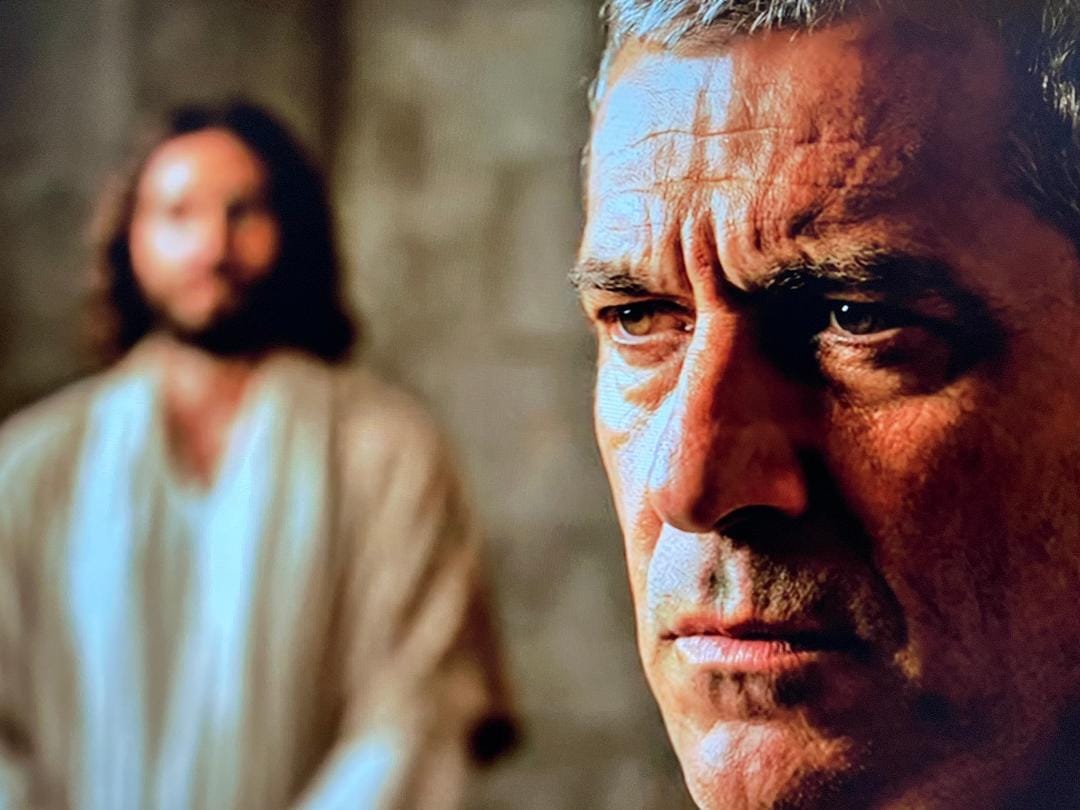
What Ever Happened to Pilate?
Pilate would not have rated an historical footnote had it not been for the thirty minutes he spent interrogating and sentencing Jesus. Only three years after this encounter, his career and life abruptly ended.
We know nothing about where Pilate was born nor his life as a young adult. Pilate was appointed the Roman Prefect or Governor of Judah (26-36 AD) under the Emperor Tiberius. He was a Roman Equestrian {knight} of the Samnite Clan of the Pontii thus his name Pontius. He was appointed the sixth Prefect of Judah by way of his close friend Sejanus, a favorite of Tiberius’. That he actually existed and had the title of Prefect was confirmed in 1961 when an excavation at Caesarea Maritima Israel unearthed a large stone inscribed with his name and this title.
Pilate had a deep dislike for the Jewish race as did Rome. He was a headstrong strict authoritarian leader who, although rational and practical, never knew how far he could go in a given case. He often provoked both Jews and Samarians to riot. He worked tirelessly to abolish Jewish laws and restrict the privileges of the Jewish Sanhedrin and Temple priesthood. He once ordered Roman troops to camp in Jerusalem and to display the pagan image of the Emperor as a god worthy of worship. The priesthood revolted and when he threated to have them executed, they agreed they would rather die that have the city desecrated. Josephus writes that Pilate was impressed by their devotion to their one God and had the images of the Emperor removed.
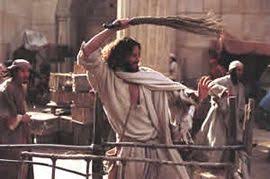
In the Spring of 33 AD, Pilate was not threatened in the least by Jesus. He showed this by not taking action against Him on the two separate occasions when He caused a riot by overturning the tables of the Temple's money changers. But when he was forced by the religious leaders to put Jesus on trial, he showed he was confused as to how exactly to handle Jesus and remain politically correct. Jesus was a Jew, but he was peaceful. He had a following, but it appeared to be just another sect of Judaism. Pilate’s biggest concern was that Jesus was said to be a miracle worker due to His being the human son of a god (John 19:7-12). Romans worshipped a pantheon of both gods and the human offspring of the gods. Therefore, Pilate did not want to offend any god or offspring if at all possible. The fact that his wife reported to him that she had experienced a nightmare about Jesus and to leave Him alone only served to increase his fears concerning the involvement of an unknown god. He even sent Jesus to be judged and sentenced by Herod Antipas, the son of Herod the Great (Luke 23:7-11). But while Herod Jr was excited to finally meet Jesus, he also well remembered the incredible agonizing death his father had experienced after he attempted to kill Jesus as an infant. Therefore, he wanted absolutely nothing to do with the man and sent Him quickly back to Pilate.
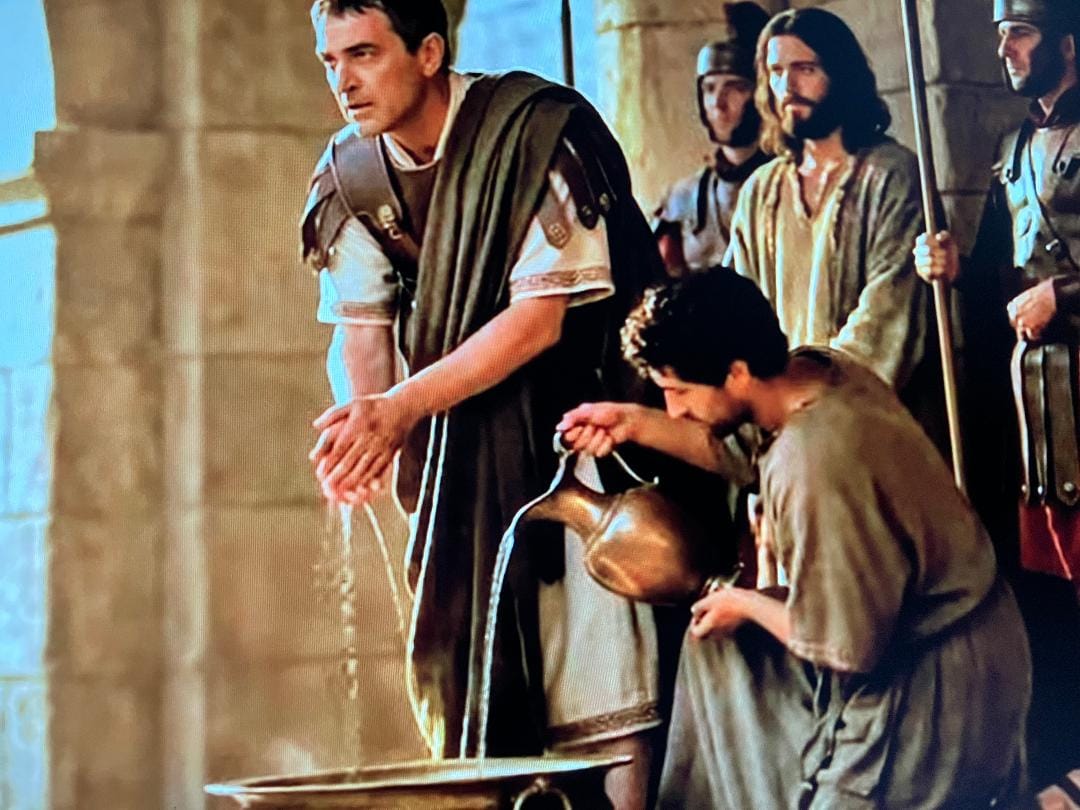
Pilate’s decision to have Jesus crucified was ultimately based on two understandings. First and foremost, Jesus refused Pilate’s request to take back His claim to be a King with a kingdom. Therefore, the Jewish leaders could file an official report to the Emperor that Pilate refused to execute a man clearly guilty of sedition against the empire. Secondly, as a personal moral matter, Pilate only allowed Jesus to be executed because of the understanding that the Jewish religious and civil authorities, along with the Jewish crowd, insisted He be executed. And, they accepted the full responsibility for the execution of an innocent man (Luke 23:2-7). It was only then that Pilate decreed that Jesus was to be crucified. He then immediately and publicly washed his hands of the entire unjust court proceedings.
Later that same evening, the Jewish leaders returned and requested Pilate station a Roman Watch at the tomb site to insure the body was not stolen (Matthew 27:65-66).
A Roman Watch consisted of 16 solders. The Watch always had four soldiers on active patrol in three hour shifts. The next four relief soldiers would be awake eating and awaiting their turn to guard the tomb for the next three hours. The other eight soldiers would eat, sleep, play cards or converses with one another awaiting their rotation shift. There was never to be a time when any less than eight soldiers were on duty and alert.
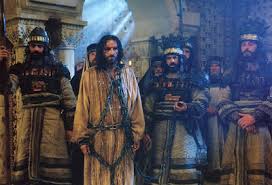
On an interesting note, while it is seldom mentioned, Scripture tells us that the Temple also stationed a Post {Mishmar} of Temple Guards to stand watch over both the tomb site and the Roman soldiers. It seems that Roman soldiers were rumored to take bribes and steal bodies for ransom. We can know there was a Temple Guard because when the Temple Priests came to Pilate to request Roman guards be posted at Jesus’ tomb, Pilate responded by saying, “you have a guard" meaning use your own guards (Matthew 27:63-65). Then Matthew tells us that “So they {the Jews} went and made the tomb {extra} sure {by seeing to it that the Roman Guard} sealed the stone and setting a Watch {using both Jewish and Roman guards}.” (Matthew 27:66) Matthew uses the Greek word “military” to describe the Roman Guard posted at the tomb. This is further made clear by Matthew when he wrote that after Jesus’ resurrection, the Roman guards showed up to tell the priests what happened and that the resurrection scared them so badly that they ran away. Therefore, they now found themselves facing certain execution by crucifixion for deserting their post (Matthew 28:4). The priests had no doubt already heard this from the Temple Guard and were relieved that the Roman Guard came to them first and did not report the resurrection of Jesus to Roman authorities. The priest paid them to say the body was stolen by a mob and also promised to make sure their commanders did not punish them (Matthew 28:11-15).

It is highly probable that the coins they used to pay the Roman Guards were some of the ones Judas had given back to them just three days earlier. You see, because the money was used to pay Judas to betray and cause the death of an innocent man, the coins were now considered by the Temple as Blood Money. Thus, the coins were deemed impure and unfit to be touched by the ritually clean priests, nor could they now be put back in the Temple treasury (Matthew 27:3-5). The hypocrisy of all of this is staggering! Scripture tells us that the priests used some of the coins to buy a cheap plot of land unfit to farm due to its heavy clay content. The land would now be used to bury strangers who died while visiting Jerusalem (Matthew 27:6-8). The rest of the coins were probably used to help pay off the pagan Roman guards.
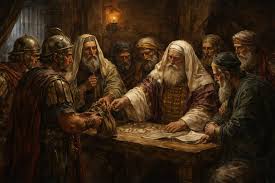
So, we can now know that the tomb of Jesus had two separate sets of guards and both reported back to the Temple that Jesus had in fact risen from the dead. Further, in the dim dawn light of Resurrection Sunday, Mary Magdalene initially mistook Jesus for the person who had stolen Jesus’ body from the tomb for a ransom (John 20:15).
It is also little known that the Temple had 24 locations in and around the Temple Mount that were manned 24/7 by Guard Posts. The Temple army consisted of 240 Levites commanded by 30 priests. This makes a total military staff of 270 well trained and devoted personnel. A Temple Post consisted of 12 Guards. If we add this number to a Roman Watch of 16 soldiers, we see that there were 28 trained and heavily armed soldiers watching the tomb of Jesus. Therefore, it would have taken an army of Jesus followers to have overtaken this heavily armed and trained guard of devoted soldiers. Not to mention the fact that there were no injuries reported on either side. Now combine this fact with the understanding that the Hill of the Skull and Jesus’ tomb was only 600 yards from the Roman Antonia Garrison. This was a fortress where Rome housed five to six hundred soldiers directly adjacent to the Temple Mount and Pilate’s palace. Therefore, it is utterly absurd that Jesus’ body was stolen in the night while a Watch of 28 men all slept only yards away from the tomb's entrance (Matthew 28:12-13).

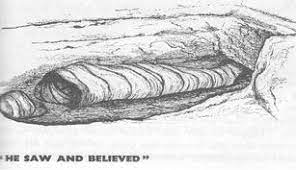
Pilate learned on Sunday morning that Jesus’ body was missing. He inquired as to how this was possible and was told that the Roman Watch was overwhelmed by the followers of Jesus, who then stole the body. The Temple Guard concurred with this hastily concocted story in lieu of excommunication from the Temple and Judaism. Later, Pilate would hear that Jesus’ body wrappings were found in the tomb laying exactly as His corpse had been wrapped, and that He was now regularly meeting with His disciples and roaming the countryside preaching to crowds with as many as five hundred people in attendance (I Corinthians 15:6). Pilate was actually relieved to hear this in that he had ordered Jesus to be crucified for sedition and he had the death certificate proving that Jesus was dead. Therefore, as far as Pilate was concerned, he had performed his duty for Rome and Jesus was in fact the son of a god who had been miraculously resurrected. So, Pilate’s duty to Rome was carried out, and at the same time, his guilty conscience was now cleared. As for the Jewish leaders, they could care less if Jesus was dead or alive as long as He never set foot in Jerusalem again.
Interestingly, Pilate sent a letter to Tiberius recounting Jesus’ claim to be the son of a god and that He arose from the dead. Tiberius then petitioned the Roman Senate to place Jesus in the official pantheon of gods. However, the Senate knew that the Jews would vehemently protest this idea and so they tabled the request.
Things in Judah quickly settled down, but unfortunately Pilate went back to his old ways. According to the famous Jewish historian Flavius Josephus, Pilate's supporter Sejanus was murdered in Rome. Without his protector in power, Pilate had no one to cover for his bad behaviors. Things came to a head when in 36 AD he ordered the brutal suppressing of an uprising in Samaria. Pilate’s troops killed a group of Samarians that were going to meet at Mt. Gerizim where the northern Jewish tribes had erected a second Temple at Tel Dan in 930 BC. The Samarian Senate sent a letter of protest to Rome. They requested that Pilate be interrogated by the Emperor concerning this senseless act of cruelty, oppression and the execution of Samarians without a proper trial. However, before Pilate arrived in Rome, Tiberius died and was replaced by Emperor Gaius.
The interrogation did not go well for Pilate. We know that he was found guilty of being unfit to serve in a leadership role. This crime carried with it the penalties of the loss of his rank, his home, all land holdings, as well as all monetary investments and savings. But the greatest toll for a former Roman officer was severe public humiliation and social ostracization. This type of punishment often included execution or being exiled usually to Gaul (modern France).
It is not clear if Pilate lived out the rest of his life in exile, or was executed, or committed suicide while in exile. The Church historian Eusebius (c.265-339 AD) wrote over two hundred and fifty years later that Pilate committed suicide. We do not know if his death was ordered by Gaius {Caligula}. It also may have been that ultimately, Pilate could not live with the shame of losing his position and killed himself as a final noble act to restore his family name and reputation. Eusebius recorded, “… having fallen into such misfortunes under Gaius, whose times we are recording, that he {Pilate} was forced to became his own murderer and executioner; and thus divine vengeance, as it seems, was not long in overtaking him.”(Eusebius of Caesarea’s Ecclesiastical History)
BUT WHAT ABOUT MRS PILATE?

Pilate’s wife's name was Claudia Procula. According to apocryphal records, she was the granddaughter of Emperor Augustus which would make her a Roman princess of sorts. Her mother was named Julia who led a notoriously promiscuous lifestyle. She was exiled by her husband Tiberius shortly before Claudia was born. After Julia’s death, Tiberius legitimized Claudia’s birth and accepted her as his stepchild. This gave her political connections and made her a desirable wife to any man looking to climb the Roman power ladder. Claudia grew up near a Roman outpost close to the Mediterranean Sea. Her arranged marriage to Pontius Pilate allowed him access to the Imperial Court where he befriended Sejanus, one of of Tiberius’ favorite administrators. Pilate became the sixth governor of Judah in 26 AD thanks to a recommendation from Sejanus.

Claudia is mentioned in the Book of Matthew as having sent her husband a prophecy revealed to her during a night terror concerning Jesus. The note was short and to the point. She wrote, “Have nothing to do with that innocent/righteous man; for last night I suffered greatly in a dream because of Him (Matthew 27:19). Some Church texts say that she personally went into the Judgement Hall to talk with Pilate. Claudia being at the palace is a distinct possibility. In 20 AD, the Roman Senate began allowing the appointed rulers of various territories the option of taking their wives to live with them. Her vivid dream followed by the news that Jesus had arisen from His tomb had a profound effect on her. She is said to have converted to the Christian religion. It is thought that she was the one who eye witnessed the trial and relayed the details to the disciples for documentation. And it is interesting to note that it was only a pagan gentile woman who dared to intervene on Jesus’ behalf. It was a woman with no authority or power who, in faith, voiced the righteousness of Jesus. Again, it was at this time that Rome was very amenable to its citizens venerating any number of gods. The only stipulation was that the Emperor was to also be considered a god. Pilate could have cared less who his wife prayed to as long as she kept it to herself. With her husband’s death, Claudia would now have been free to return to Rome and resume her life as a respected member of Roman royalty.
Jesus had prophesied on three occasions that He would not only be executed, but His death would be by crucifixion. He was also clear that this act would be a self-sacrifice in order to seal in blood a new more perfect Covenant. A Covenant that would allow mankind access to forgiveness of sin and eternal life through faith plus nothing else. Therefore, while the Jewish religious leaders are to be rightly condemned for colluding with Rome {the world} to have Jesus unjustly executed {sacrificed}, it was necessary for Pilate to authorize His execution. However, Pilate made it clear he was an unwilling participant in the event. He publicly announced he was against the decision of the crowd and then ceremoniously washed his hands of any involvement in what he considered to be a perverse trial that ended in the death of an innocent man.
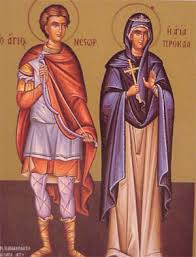
This explains how and why Pilate and Claudia would become venerated by the early Church as Saints. The Ethiopian Orthodox Church, and the Eastern Orthodox Church still honor them by observing feast dates in June {Pilate} and October {Claudia}.
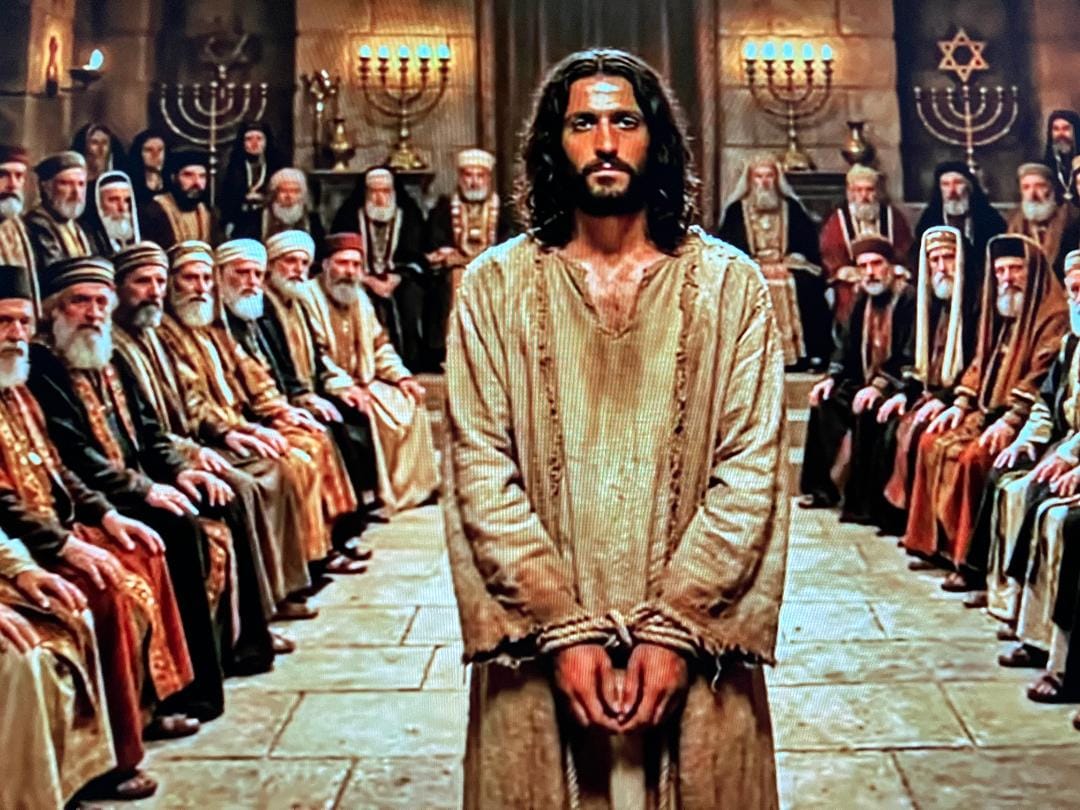
On a closing note, Jesus’ attended seven trials that occurred over a nine hour timespan. He was first tried by the retired High Priest Annas, then the High Priest Caiaphas, then the Sanhedrin, then Pilate, then Herod Jr., then back to Pilate and finally, the Jewish public. During that time, seven unlikely people would verbally proclaim His innocence, and in several cases His Deity; Judas Iscariot (Matthew 27:4), Pontius Pilate (Luke 23:4), Herod Antipas (Luke 23:15), Pilate's Wife (Matthew 27:19), the Dying Thief (Luke 23:41), the Roman Centurion (Luke 23:47) and the Roman and Temple Guards at His tomb (Matthew 27:54).
What an unbelievable diverse cast of characters who each reached their own diverse understanding of who Jesus was. The Jewish leaders saw Him as an existential threat to the continuation of Judaism and the Jewish race. Judas saw Him as an innocent Rabbi. Pilate saw Him as an innocent leader of a Jewish cult. Herod saw Him as a man with diabolical supernatural powers. Pilate's wife saw Him connected in some way with the gods. The dying thief saw Him as the prophesied Messiah. The Roman Centurion saw him as a god in that He commanded Himself to die while on His cross. The Roman Guards saw Him as an unknown resurrected God. And the Temple Guards, no doubt, now saw Him as the Messiah who was wrongly executed, but had now returned just as prophesied (Zechariah 13:6; Daniel 9:26).
Thus we can rightly conclude that the opinions of those who met Him over this nine hour period ranged from a diabolical quintessential threat to the Jewish race, to a mysterious and powerful enigma, to God incarnate. The real question is, who do you think He is?
If you enjoy the information provided on this site, please consider making a donation of any amount to help continue its production. Donate Now